Lord David Dirry-Moir
The Man Who LaughsLord David Dirry-Moir is the natural son of Linnæus, Lord Clancharlie, and a courtier whose fortunes survive successive changes of monarch. Raised within the royal household rather than by his exiled father, he becomes a privileged servant of the crown, a naval officer, and the presumed heir to the Clancharlie peerage. His eventual encounter with Gwynplaine turns that apparent ascent into a collision between hereditary rank and the man whose identity makes the inheritance his own.
Identity and Origins
Lord David is born in England in the final days of the republic, just as his father is going into exile. He never sees Linnæus, Lord Clancharlie. His mother is a woman of quality, and after Lord Clancharlie’s departure she becomes the mistress of Charles II. The king’s favour gives the child a place at court: he is appointed keeper of the stick, boarded at royal expense, and grows into an ardent supporter of the Stuarts.
His courtesy title is initially associated with his service and standing at court. When his mother dies, she leaves him an estate in a Scottish forest; with James II’s permission, he takes the name Dirry-Moir from that property. The change makes a family inheritance visible in his title, but his larger prospects still depend on royal patronage. His birth connects him to an exiled republican lord; his upbringing and advancement attach him to the monarchy that displaced his father.
Advancement at the Stuart Court
Under Charles II, Lord David occupies several places in the royal household. He belongs first to the company of guardsmen who wear the great sword, then to the corps of pensioners, whose members bear gilded halberds. He also has the privilege of laying dishes on the king’s table. These duties give him ceremonial proximity to the monarch as well as a livelihood paid for by the court.
James II promotes him to gentleman of the bedchamber, a post that requires its holder to sleep near the king in a bed made up for him. Lord David receives a salary of a thousand pounds a year in that office. He also manages the royal granary, distributing corn for the horses for an additional £260 annually. Beneath his authority are the king’s coachmen, postilions, grooms, footmen, and chair-bearers. His responsibilities extend to the racehorses at Newmarket, which cost the king £600 a year, and to the wardrobe from which ceremonial robes for the Knights of the Garter are supplied. The offices are distinct, but together they make him a manager of the practical machinery and display of royal life.
Political Service and Character
Lord David’s court career continues after William III takes the throne. His Jacobite allegiance does not lead him to follow James II into exile: he serves the new ruler while continuing to regard the former king as legitimate. The narrative presents this accommodation as a defining political flexibility. He is willing to serve the state and the reigning prince without making his dynastic sympathies a barrier to advancement.
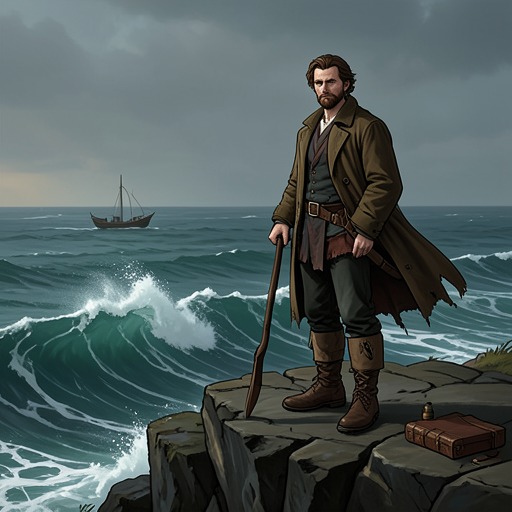
He transfers from the land forces to the sea and distinguishes himself in the White Squadron, rising to command a light frigate. The portrait combines military competence with elaborate courtliness. He is assiduous at feasts, galas, receptions, ceremonies, and in battle; brave when a royal signal calls for risk, attentive to etiquette, and capable of both deference and arrogance. His manners are polished, while the account also describes him as extravagant and inclined to the elegancies of vice. At forty-five he remains, in the narrator’s deliberately admiring and mocking formulation, quite young.
His independent income is about £10,000 a year, inherited from his mother, but it does not prevent him from running into debt. He spends freely on magnificence and novelty, changing his style as soon as it is copied. Unusual hats, distinctive lace, patterned bands, and turned-over cowhide riding boots make dress another arena in which he asserts individual distinction. His cultivated interests include French songs, poetry, eloquence, and the funeral orations of Bossuet. This refinement sits alongside his dependence on royal favour: his persona is at once that of the gallant officer and the attentive courtier.
The Presumed Heir and the Succession
Lord David’s claim to the Clancharlie inheritance is made official amid rumours about his father’s final years. Reports circulate that the old exile married Ann Bradshaw in Switzerland and that she died giving birth to a son. If true, the child would be Lord Clancharlie’s legitimate heir. The rumours remain uncertain, but James II ends their public force by declaring Lord David the sole heir in default of legitimate issue and registering patents in the House of Lords.
The grant gives Lord David the late lord’s titles, rights, and prerogatives on a condition: he must marry the Duchess Josiana once she reaches marriageable age. The crown has made the infant Josiana a duchess, and the peerage is framed around her and her future husband. It comprises the baronies of Clancharlie and Hunkerville, with the associated marquisate of Corleone in Sicily. Thus Lord David’s expected inheritance is not simply an individual reward. It is a royal settlement that joins his succession to a marriage arranged in childhood.
The reports of a legitimate son prove decisive when Gwynplaine is recognized as the rightful heir. Lord David is sent to sea off the coast of Flanders while the matter is kept from him and Josiana. Queen Anne replaces Captain Halyburton’s proposed promotion with Lord David’s name, appointing him vice-admiral so that he may have that advancement when he is no longer a peer. The promotion is therefore both a real elevation in naval rank and an acknowledgement that the hereditary status on which his earlier fortune depended is about to be lost.
Gwynplaine and the Windsor Confrontation
Lord David is ordered back from sea to Windsor to receive the queen’s commands. There, in a magnificent naval uniform, with a plumed hat in hand and a French song on his lips, he enters the room where Gwynplaine is present. Each recognizes the other: Gwynplaine knows him as Tom-Jim-Jack, while Lord David knows the man before him as Gwynplaine. The old name from their earlier encounter and the titles now claimed by each bring two social worlds into the same room.
Lord David refuses to answer questions and insists that Tom-Jim-Jack is not his name; Gwynplaine, in turn, says that Gwynplaine is not his. Lord David says that he is in his own house and distinguishes the rules governing their former meeting from those at Windsor. At the Tadcaster Inn, he could box with Gwynplaine; in his house, he argues, a sword is a gentleman’s weapon and he can fight with it only against an equal. He identifies himself as a rear-admiral and warns Gwynplaine that he can order him flogged. Gwynplaine answers with his claim to be a peer of England and Lord Clancharlie.
The exchange makes rank a weapon in its own right. Lord David treats military authority as a practical power over Gwynplaine, while Gwynplaine invokes the hereditary title that Lord David has been expected to inherit. Lord David laughs at the claim, even as the audience knows that the succession has already shifted against him. His laughter marks the scene’s reversal: the man who once possessed the title by royal grant confronts its rightful bearer without yet accepting that the status he relies on is no longer secure.
Narrative Role
Lord David’s story links personal advancement to the institutions that distribute privilege. His offices, salaries, ceremonial access, and presumed inheritance are bestowed through royal decisions; even his promotion to vice-admiral is made significant by the prospect that he will lose his peerage. He adapts across the transitions from Charles II to James II and William III, preserving service and rank where political loyalty might have required exile.
The meeting with Gwynplaine condenses that history into a dispute about who may claim equality, who may command, and what makes a gentleman. Lord David is not merely displaced by a competing heir: his confidence in the force of titles and office makes the displacement visible. At Windsor, naval uniform and aristocratic inheritance stand face to face, and the laughter that once accompanied Lord David’s assured position becomes the sound of a hierarchy failing to protect him from its own rules.